






Professional knowledge
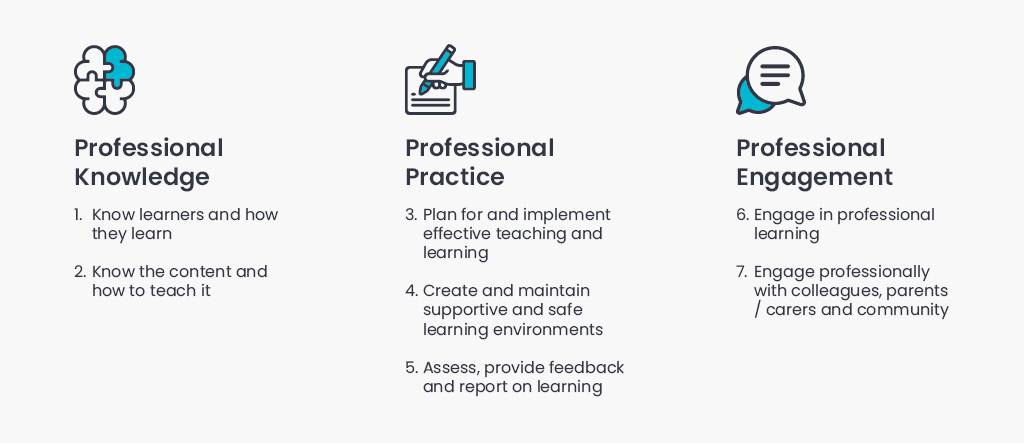
1. Know learners and how they learn
1.1 Physical, social and intellectual development and characteristics of learners
Use teaching strategies based on knowledge of learners' physical, social and intellectual development and characteristics to improve their learning.
1.2 Understand how learners learn
Structure teaching programs using research and collegial advice about learning.
1.3 Learners with diverse linguistic, cultural, religious and socioeconomic backgrounds
Design and implement teaching strategies that are responsive to the learning strengths and needs of learners from diverse linguistic, cultural, religious and socioeconomic backgrounds.
1.4 Strategies for teaching Aboriginal and Torres Strait Islander learners
Design and implement effective teaching strategies that are responsive to the local community and cultural setting, linguistic background and histories of Aboriginal and Torres Strait Islander learners.
1.5 Differentiate teaching to meet the specific learning needs of learners across the full range of abilities
Develop teaching activities that incorporate differentiated strategies to meet the specific learning needs of learners across the full range of abilities.
1.6 Strategies to support full participation of learners with disability
Design and implement teaching activities that support the learning and participation of learners with disability and address relevant policy and legislative requirements.
2. Know the content and how to teach it
2.1 Content and teaching strategies of the teaching area(s)
Apply knowledge of the content and teaching strategies of the teaching area(s) to develop engaging teaching activities.
2.2 Content selection and organisation
Organise content into coherent, well-sequenced learning and teaching programs.
2.3 Curriculum, assessment and reporting
Design and implement learning and teaching programs using knowledge of curriculum, assessment and reporting requirements.
2.4 Understand and respect Aboriginal and Torres Strait Islander people to promote reconciliation between Indigenous and non-Indigenous Australians
Provide opportunities for learners to develop understanding of and respect for Aboriginal and Torres Strait Islander histories, cultures and languages.
2.5 Literacy and numeracy strategies
Apply knowledge and understanding of effective teaching strategies to support learners' literacy and numeracy achievement.
2.6 Information and Communication Technology (ICT)
Use effective teaching strategies to integrate ICT into learning and teaching programs to make selected content relevant and meaningful.
Professional practice
3. Plan for and implement effective teaching and learning
3.1 Establish challenging learning goals
Set explicit, challenging and achievable learning goals for all learners.
3.2 Plan, structure and sequence learning programs
Plan and implement well structured learning and teaching programs or sequences that engage learners and promote learning.
3.3 Use teaching strategies
Select and use relevant teaching strategies to develop knowledge, skills, problem solving and critical and creative thinking.
3.4 Select and use resources
Select and/or create and use a range of resources, including ICT, to engage learners in their learning.
3.5 Use effective communication (with learners)
Use effective verbal and non-verbal communication strategies to support understanding, participation, engagement and achievement of learners.
3.6 Evaluate and improve teaching programs
Evaluate personal teaching and learning programs using evidence, including feedback and assessment data from learners, to inform planning.
3.7 Engage parents/carers in educative process
Plan for appropriate and contextually relevant opportunities for parents/carers to be involved in their children's learning.
4. Create and maintain supportive and safe learning environments
4.1 Support participation of learners
Establish and implement inclusive and positive interactions to engage and support all learners in learning activities.
4.2 Manage learning and teaching activities
Establish and maintain orderly and workable routines to create an environment where time is spent on learning tasks.
4.3 Manage challenging behaviour
Manage challenging behaviour by establishing and negotiating clear expectations with learners and address discipline issues promptly, fairly and respectfully.
4.4 Maintain safety of learners
Ensure the wellbeing and safety of learners within the learning environment by implementing curriculum and legislative requirements.
4.5 Use ICT safely, responsibly and ethically
Incorporate strategies to promote the safe, responsible and ethical use of ICT in learning and teaching.
5. Assess, provide feedback and report on learning
5.1 Assess learning
Develop, select and use informal and formal, diagnostic, formative and summative assessment strategies to assess learning.
5.2 Provide feedback to learners about their learning
Provide timely, effective and appropriate feedback to learners about their achievement relative to their learning goals.
5.3 Make consistent and comparable judgements
Understand and participate in assessment moderation activities to support consistent and comparable judgements of learning.
5.4 Interpret data from learners
Use assessment data from learners to analyse and evaluate understanding of content, identifying interventions and modifying teaching practice.
5.5 Report on achievement of learners
Report clearly, accurately and respectfully to learners and parents/carers about achievement, making use of accurate and reliable records.
Professional engagement
6. Engage in professional learning
6.1 Identify and plan professional learning needs
Use the Australian Professional Standards for Teachers and advice from colleagues to identify and plan professional learning needs.
6.2 Engage in professional learning and improve practice
Participate in learning to update knowledge and practice, targeted to professional needs and priorities of the education setting or system.
6.3 Engage with colleagues and improve practice
Contribute to collegial discussions and apply constructive feedback from colleagues to improve professional knowledge and practice.
6.4 Apply professional learning and improve learning (of learners)
Undertake professional learning programs designed to address identified needs of learners.
7. Engage professionally with colleagues, parents/carers and the community
7.1 Meet professional ethics and responsibilities
Meet codes of ethics and conduct established by regulatory authorities, systems and education settings.
7.2 Comply with legislative, administrative and organisational requirements
Understand the implications of and comply with relevant legislative, administrative and organisational and professional requirements, policies and processes.
7.3 Engage with parents/carers
Establish and maintain respectful collaborative relationships with parents/carers regarding their children's learning and wellbeing.
7.4 Engage with professional teaching networks and broader communities
Participate in professional and community networks and forums to broaden knowledge and improve practice.
The Victorian Institute of Teaching acknowledges the diversity of teaching contexts and uses inclusive language to describe the professional standards for teachers.
- Australian Professional Standards for Teachers - proficient level (PDF, 632.54 KB)
- Registration categories
- Maintaining my registration
- Renewing my registration
-
Moving to (full) registration
- Inquiry approach
-
Watch how to become (fully) registered with the VIT
- Watch ‘How to become (fully) registered – an overview
- Watch: ‘What you need before you begin'
- Watch 'How to choose the learners for your evidence based process'
- Watch 'How to develop your inquiry question'
- Watch ‘How to work with your mentor or experienced colleague’
- Watch ‘How to develop and implement your action plan’
- Watch ‘How to evaluate your practice’
- Watch ‘How to present to the recommendation panel’
- Watch ‘Other contexts’
- Recommendation process
- Resources
- Watch and listen
- Seminar information
- Illustrations of ECT practice
- Recognition of prior experience
- Effective Mentoring Program
- Casual relief teachers
- VIT’s new teacher registration system
- Returning to teaching
- Non-practising registration
- Special Needs Plan
- Nationally Coordinated Criminal History Check
- Standards
- Fees